Overview
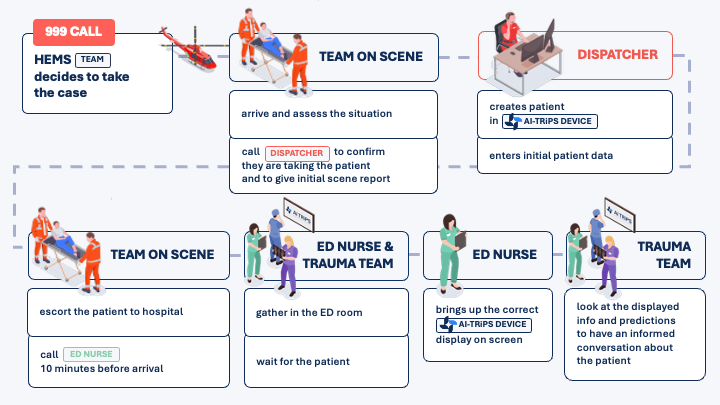
The Artificial Intelligence in Trauma Risk Prediction System (AI-TRiPS) trial will evaluate the use of AI-powered decision-support tools in trauma care. In trauma care, time-critical treatment decisions often rely on clinicians’ judgment of risk. These decisions can be challenging due to inadequate information, high uncertainty, and time constraints. The AI-TRiPS system has been designed to be user-friendly, providing clear and accessible insights to doctors making decisions about seriously injured patients. It provides evidence-based predictions about the risks faced by critically injured patients and guidance on how best to manage these on arrival in hospital.
The £1.8m study is funded by the Congressionally Directed Medical Research Programs. It is one of the first randomised-controlled trials to evaluate the use of AI-powered decision-support tools in trauma care. It will evaluate the effectiveness of AI-TRiPS in supporting doctors assess the risks of life-threatening complications, such as severe blood loss, and support them in taking action to improve outcomes. If successful, this initiative could revolutionise trauma care worldwide and help save thousands of lives.
The trial will see AI-TRiPS deployed across The London Trauma System, the largest integrated trauma network in the world. The trial is a collaboration between Queen Mary University London, the University of Aberdeen, London’s Air Ambulance and the London Ambulance Service and is led by Professor Nigel Tai, QMUL.